
GLP‑1 receptor agonists—semaglutide (branded Ozempic/Wegovy) and tirzepatide—are renowned for weight loss and blood sugar control. Recent studies show they may also help people with knee osteoarthritis (OA) in meaningful ways—beyond just trimming fat.
1. How These Drugs Help OA of the Knee
🔹 Weight Loss = Knee Relief
- Major clinical trials show once-weekly semaglutide led to a ~14% body-weight decrease and ~42-point pain improvement on WOMAC scores versus placebo (~3% and ~28 points) after 68 weeks in obese adults with knee OA [1][2].
- One such trial was theThe STEP 9 trial showed semaglutide led to weight loss, pain reduction (WOMAC pain score), and improvement in physical function (SF-36 score) in adults with obesity and moderate-to-severe knee osteoarthritis.
- Weight reduction in obese individuals reduces mechanical burden on joints and lowers systemic inflammation—two important drivers of OA progression [1][2].
🔹 Added Anti‑Inflammatory Effects
- GLP‑1 agonists provide beyond-weight benefits, like reduced inflammatory signals and cartilage preservation [1][3][4].
- Some studies report slower cartilage loss and fewer knee surgeries in patients on these medications—suggesting a disease-modifying role [1][3].
2. Who Benefits Most? Obesity or Anyone with Arthritis?
✅ Most Effective in Obese Patients
- The strongest data come from patients with obesity + knee OA (average BMI ~40). In this group, semaglutide and tirzepatide both produced significant weight loss and meaningful pain relief [1][5].
- Economic evaluations found adding GLP‑1s to usual care is cost-effective compared to lifestyle-only approaches, especially for tirzepatide [5][6].
❓ Less Clear for Leaner Individuals
- There’s limited evidence for non-obese people with OA. Guidelines emphasize first-line OA care—exercise, joint injections, weight management, pain meds—but GLP‑1s aren’t yet approved as OA-specific treatments [7][3].
- Experts caution: most trials involve obese cohorts. We need more research to know if GLP‑1s help those with mild obesity or no obesity [7][4].
- For all managing OA, you need to maintain muscle strength,.
3. Caveats & Considerations
- Muscle loss risk: GLP‑1s reduce both fat and lean muscle mass—potentially harmful for OA patients if not paired with strength training [7]. Emsculpt (see below) and personal training fitness is helpful at combating this.
- Weight rebound: Stopping therapy may cause rapid weight gain, potentially erasing benefits [7].
- Joint replacement paradox: Early data hint at higher rates of joint replacement among users, though reasons are unclear [7].
- Side effects: GI symptoms like nausea are common; long-term safety for joint health still being studied [4][3].
4. Bottom Line: Prescription, Not Panacea
| Consideration | What We Know |
|---|---|
| Best for whom | Those with obesity and knee OA see the greatest benefit. Less proven for non-obese OA patients. |
| Primary benefit | Weight loss → pain reduction + improved joint function. |
| Other potential | Anti-inflammatory, cartilage-sparing effects might provide disease moderation. |
| Risks | Lean mass loss, weight regain, GI side effects, unclear joint replacement risk. |
GLP‑1s are not currently FDA-approved specifically for arthritis. They should be considered as part of a comprehensive weight and lifestyle program, not a standalone “arthritis fix.”
🎯 5. Advice for Your Knees
- If you have obesity with knee OA, talk to your doctor about semaglutide or tirzepatide—they may offer substantial pain and mobility benefits alongside weight loss. [1][5]
- Without obesity, explore standard OA care first: exercise, weight management, physical therapy, joint injections.
- If GLP‑1s are considered, combine them with strength training and ongoing monitoring to offset muscle loss and maintain gains.
- Watch for new research—evidence is evolving, and GLP‑1s could soon be considered beyond weight-driven OA treatment [7][4]. Evidence is now accumulating that fitness management with muscle improvement is important.
💪 6.Emsculpt for Glutes & Thighs: A Game-Changer for Knee Support
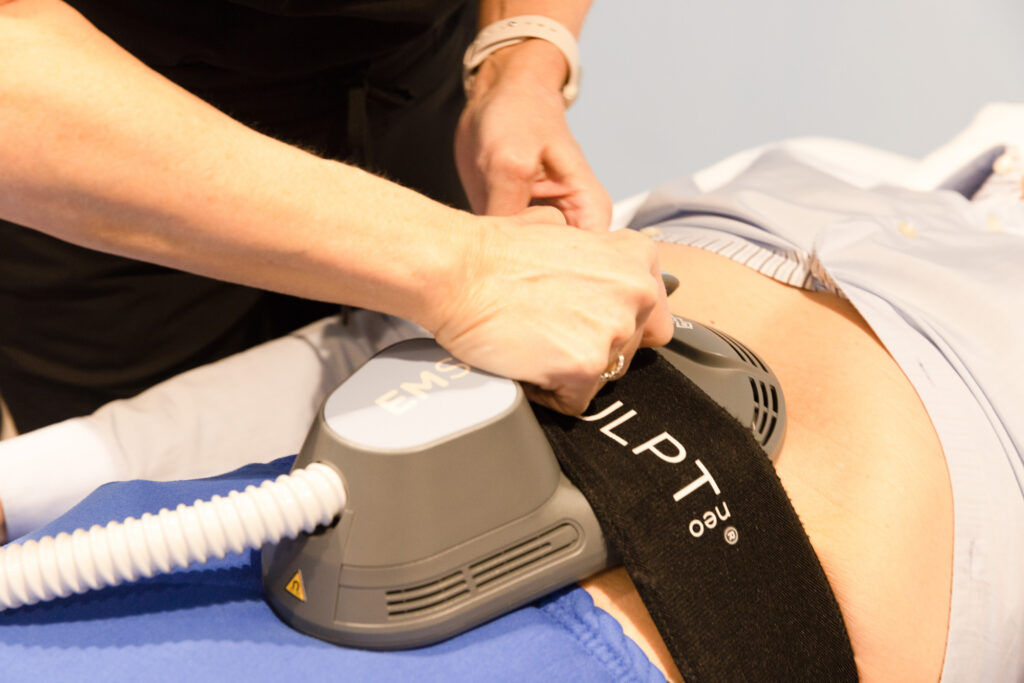
For patients with knee osteoarthritis who can’t tolerate squats or high-impact exercise, our Emsculpt treatments offer a powerful alternative to build strength and stability—without stressing the joints.
🔹 How It Works
Emsculpt uses high-intensity focused electromagnetic (HIFEM) technology to stimulate thousands of muscle contractions in the glutes and thighs. This mimics the effects of intense workouts, helping to:
- Strengthen leg muscles that support the knee joint
- Improve balance and mobility, reducing fall risk
- Enhance joint stability, especially in those with weak quadriceps or glutes
- Reduce inflammation by promoting circulation and muscle activation
🔹 Why It Matters for OA
Strong glutes and thighs are essential for offloading pressure from the knees. When these muscles are underdeveloped—often due to pain or inactivity—knee joints bear more stress, accelerating cartilage wear. Emsculpt helps reverse that cycle, even for those who can’t do traditional strength training.
🔹 Ideal for Non-Exercisers
Whether due to pain, age, or mobility limitations, many OA patients struggle with exercise. Emsculpt provides a non-invasive, low-barrier way to rebuild muscle tone and function—making it a perfect complement to GLP‑1 therapy or other weight-loss strategies.
🔍7.Final Takeaway
Individual strategies work the best, we advise exercise, diet, medication, and Emsculpt and each person needs individual strategies. For us both Emsculpt and GLP‑1 agonists show great promise—especially for those whose knee pain is worsened by obesity. For non-obese OA patients, their role is less clear. For some women hormone management may be necessary in order to build maximum amounts of muscle. Side effects, long term weight strategies, should be part of a bigger therapeutic picture, tailored carefully to each patient.
[8] Once-Weekly Semaglutide in Persons with Obesity and Knee Osteoarthritis. Bliddal H, Bays H, Czernichow S, et al. The New England Journal of Medicine. 2024;391(17):1573-1583. doi:10.1056/NEJMoa2403664.
[9] In Adults With Obesity and Knee OA, Adding Weekly Semaglutide to Diet and Activity Counseling Reduced Weight and Knee Pain at 68 Wk. Bell DSH. Annals of Internal Medicine. 2025;178(2):JC20. doi:10.7326/ANNALS-24-03988-JC.